Dr. Hilarius
The Crying of Lot 49Dr. Hilarius is Oedipa Maas’s psychotherapist, a figure whose comic therapeutic eccentricity turns into a terrifying encounter with the history he has tried to escape. He prescribes tranquilizers while secretly recruiting suburban housewives for a drug experiment; later, armed and convinced that pursuers are coming for him, he discloses that he helped induce insanity in prisoners at Buchenwald. His past makes his treatment of Oedipa—and his own claim to have sought atonement—impossible to separate from coercion, guilt, and the unstable boundary between diagnosis and delusion.
Identity and Therapeutic Practice
Hilarius is introduced as the psychiatrist Oedipa consults, but the relationship is marked from the start by her uncertainty about what his treatment entails. After a late-night call, she refuses the pills he has given her, saying she does not trust them to be merely tranquilizers. His response does not reassure her: he turns the question toward whether she trusts him, while the urgency of his call reveals another purpose behind his interest in her.
That purpose is an experiment he calls the bridge. Hilarius is helping a community hospital study the effects of LSD-25, mescaline, psilocybin, and related drugs on a large sample of suburban housewives, and he wants Oedipa included as the hundred-and-fourth subject. The clinical language of a research schedule makes her sound like a place to be filled, not a patient whose consent has been earned. She refuses, pointing out that it is three in the morning and that he has many other possible subjects. His insistence that they want her leaves the request ominously personal without explaining why she has been selected.
Hilarius’s practice is also defined by a self-fashioned repertoire of unorthodox techniques. He believes that a face can work like a Rorschach blot or a Thematic Apperception Test, producing a response through its arrangement. He claims to have cured hysterical blindness with one expression, the “Fu-Manchu,” made by pulling the eyes, nostrils, and mouth into a grotesque configuration and protruding the tongue. Oedipa has encountered his faces before, but during a sleepless night one of them returns in her mind after a hallucinated image of Uncle Sam. The method that Hilarius presents as therapeutic suggestion therefore also registers as an invasive, frightening power over perception.
The Clinic Siege
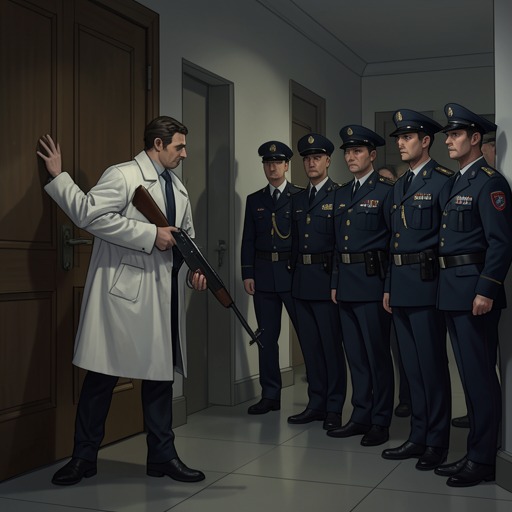
When Oedipa drives to the clinic after a day spent following evidence of W.A.S.T.E., she hopes Hilarius will tell her that the system she has encountered is a delusion and that she needs rest. Instead, a gunshot sounds as she approaches the darkened building. The doors are locked; she throws a rock at the glass, then sees Hilarius’s assistant, Helga Blamm, appear inside and let her in. Blamm explains that Hilarius has gone mad, smashed the telephone switchboard with a chair, and barricaded himself in his office with a rifle.
The danger is not confined to Oedipa’s interpretation of events: Blamm says Hilarius has shot at half a dozen people. Yet she has stayed, explaining that he might need somebody. Oedipa, too, moves toward the crisis rather than simply fleeing. She notices that a window in Blamm’s office offers a safe route of retreat, but she remains involved as police arrive and ask her to keep Hilarius occupied. The contrast between the available escape and the choice to stay gives the scene its human tension: the clinician who has treated others as subjects is now isolated, armed, and dependent on the presence of people he suspects.
From behind the office door, Hilarius asks Oedipa whether he has seemed a good enough Freudian and recalls trying to submit himself to Freud’s teachings. He describes that allegiance as penance: after the atrocities he took part in, he tried to believe in a vision of human life in which the camps could be transformed by the arrival of light. His insistence that the police may be agents sent to take him away makes it unclear how much of the immediate threat is real and how much belongs to his paranoia. But the past he reveals is not simply an invention of the siege. He names Buchenwald as the place where he made the face he has been describing.
Buchenwald and the Meaning of Penance
Hilarius tells Oedipa that he worked on experimentally induced insanity at Buchenwald. In his account, a catatonic Jewish prisoner was treated as effectively dead, and liberal SS circles justified the work as more humane than killing. The experiments used metronomes, serpents, theatrical scenes at midnight, gland removal, hallucinations, drugs, threats broadcast through hidden loudspeakers, hypnotism, clocks running backward, and faces. Hilarius was responsible for the faces. The list turns the eccentric practice Oedipa has known as a psychiatrist’s oddity into a technique developed inside a system of systematic brutality.
He singles out one supposed success, a prisoner named Zvi, who saw the face Hilarius made during his internship. Hilarius claims that the face drove Zvi into lasting insanity; he imagines the surviving man as now hopelessly ruined. The account is therefore both a confession and a renewed performance of the power he attributes to himself. As he describes the face’s supposedly devastating effect, he asks Oedipa to tell the police about its reach and its capacity to drive a witness into darkness. The scene leaves the claim’s supernatural force unverified, but binds the present-day spectacle of Hilarius’s threatening faces to an actual history of experimentation on prisoners.
Hilarius frames his later allegiance to Freud as an effort to atone. He says he chose Freud rather than Jung and tried to believe in a humane account of the world, one that could imagine the spaces of the camps remade for ordinary life. He recalls sleeping only three hours a night, spending the rest of his time trying to force himself into that faith, and still concluding that his penance had not been enough. The gap between the enormity of his past and the modest, self-directed practice he offers as redemption is unresolved: he can describe the attempt to believe, but cannot make it undo what he did.
Oedipa, Mucho, and the Limits of Diagnosis
During the siege, Hilarius tries to recruit Oedipa into his fear by saying that people in uniform may not be safe and that she cannot know where the police would take him if he surrendered. He asks her to convey his claim about the face to them. When officers break into the clinic, he pulls Oedipa into his office and locks the door again, making her his hostage as well as his interlocutor. She tells him not to shoot at the police, but he continues to treat them as possible agents of persecution. His position as doctor and authority has collapsed into a demand that his patient validate his account of danger.
Oedipa sees that Hilarius has left his Gewehr 43 on the desk and picked it up. She tells him she ought to kill him, while recognizing that he wanted her to take the weapon. The gesture exposes a crisis of agency within the room: Hilarius’s apparent surrender of the rifle may itself be an attempt to make Oedipa act for him, while her threat does not settle what she will do. The standoff ends with the weapon and its intended use becoming part of the same unstable exchange between doctor and patient.
Hilarius’s influence extends beyond Oedipa. Mucho tells her that he obtained LSD from Hilarius, who had broadened his program to include husbands. Mucho cannot honestly remember how long he has been taking it. This disclosure gives the doctor’s research a consequence inside Oedipa’s marriage: the experiment she refused to join has reached her husband, and the drug has become part of a condition whose duration he cannot track. Hilarius’s clinical program thus joins several forms of uncertainty in the novel—whether Oedipa’s perceptions are reliable, whether authority can be trusted, and whether a person can retain a stable account of his own experience.
Narrative Significance
Hilarius connects the language of psychiatric treatment to both institutional violence and the novel’s larger instability of evidence. His drug study can be described as medical research, but its recruitment of Oedipa comes by way of an unexplained three-in-the-morning demand, and his later extension of the program to husbands reaches Mucho without producing a clear record of how long he has been exposed. His theories of faces likewise oscillate between clinical technique, grotesque theater, and a claim of lasting psychic destruction.
His Buchenwald confession sharpens that ambiguity rather than resolving it. The revelation explains why Hilarius treats his Freudian practice as penance and why the history behind his faces is so disturbing; it does not establish that every fear during the siege is true, or that his self-described atonement has repaired anything. Oedipa seeks him as a possible authority who might distinguish delusion from reality, but finds a doctor implicated in deception, coercive research, and a past he cannot master. He is at once a source of information and another reason not to trust the person supplying it.